
Lesson 2: The Clean Stream Team
Lesson 2 will take 2 hours to complete and be graded by a multiple-choice quiz.
In this lesson:
• Learn more about Pink Salmon, (some) Sockeye and (some) Chum salmon
• Define the common critical life cycle attributes of this grouping of salmon
• What works for Sockeye in the Upper Pitt River
• What works for Pink in the Squamish River
• Habitat restoration techniques aimed at Chum salmon

Our next basket of species
• These salmon don’t rear in streams, they move directly to the ocean (or a large lake)
• Population health is primarily controlled by stable, clean surface run-off water that flows over suitable gravel streambeds for spawning
• This means the key habitat to restore is the spawning ground
• Timing for spawning is August through October, with most populations coming in mid-September to mid-October

Biology basics, temperature & timing
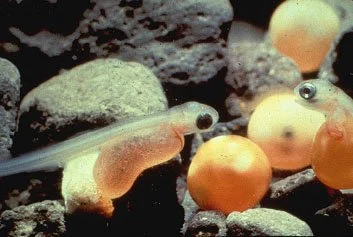
Salmon are cold-blooded. Because of this, salmon eggs develop quicker in warm water than in cold water.
• Ideally, salmon want their young fry to be ready to leave their gravel beds by April 1
• It takes about 1000 thermal units to get a salmon egg to a ready to go
• Each population of salmon will spawn at a time that reflects how warm their home streams are in the fall, winter and spring: if you see salmon spawning in August, then that stream is colder than when you see salmon spawning in mid-November. Colder streams require a longer time period.
• Mountain-fed streams tend to be colder than streams flowing out of large lakes (like Harrison Lake, pictured here)
Eg:. Upper Pitt River Chinook spawn early (August-September) in their cold, mountain-fed stream while their cousins in Harrison River – downstream of the really big Harrison Lake – wait until October-November.
• The Clean Stream Team = Pink salmon (all timings) + Chum (Early-Mid timing) + Sockeye (Early-Mid timing)
Stable spawning grounds are key
The Clean Stream Team are critically reliant on the stability and quality of water flows – more so than other salmon.
•Major flooding moves gravel and sweeps salmon eggs out of their redds
•Silt falling off a streambank suffocates the eggs
The fry from this group move quickly when they emerge from the gravel – to the ocean for pink and chum and the lake for sockeye.
So, if you improve or restore the amount of stable, high-quality spawning areas for these three species, their populations have the potential to grow to almost unlimited size.
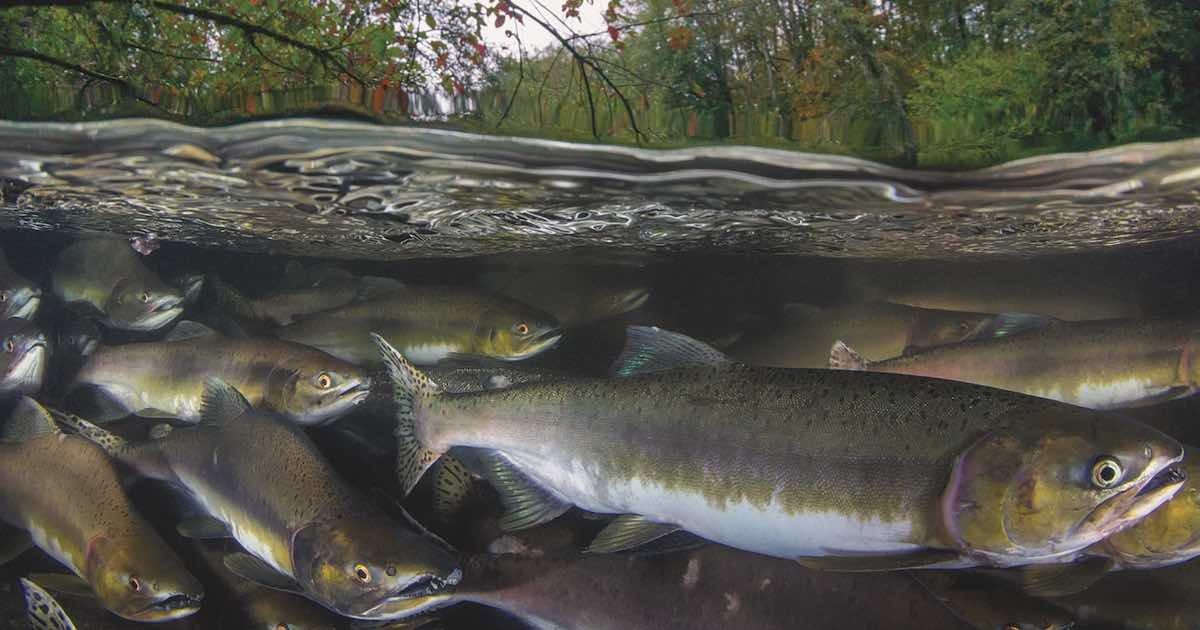
85% of the salmon in the North Pacific Ocean are on the Clean Stream Team, likely because they spend less of their lives in streams (near humans) and more of their lives in the ocean.
Pink and chum salmon prefer to spawn downstream of lakes: they don’t like to pass through lakes, where there are larger fish that might eat the fry. They get to the ocean as soon as possible.
Sockeye salmon prefer to spawn above lakes so their little fry can easily flow downstream into the lake. They stay there and grow larger, heading down to the ocean as much bigger smolts that are harder for predators to catch.
Conveniently, these differing strategies mean that pink, sockeye and chum aren’t fighting each other for redd sites.
Spawning ground preferences
Chum are bigger than Pinks
Chum will dominate Pinks in high-quality spawning areas
There’s an exception: pinks survive better in somewhat less stable rivers than Chum salmon, so you will see Pinks dominating over Chums in poorer quality habitats.
Sockeye won’t travel as far as Chinook
In the Upper Pitt River, which we know from Lesson 1 is very unstable during fall and winter flooding, Chinook have found good spawning grounds in Blue Creek. But at 30 km upstream from Pitt Lake, Blue Creek is too far from safety for Sockeye to survive. Instead, they seek out the few stable spots that exist closer to the lake – here is an opportunity for habitat restoration work that could create more of the spawning ground these Sockeye are looking for.

Pink salmon

Chum salmon

Chinook salmon
Case study: Looking at the sockeye in Upper Pitt River
Spawning sockeye in the Upper Pitt River look for more stable tributaries – quiet channels like Corbold Creek.
The construction of logging roads over the last century have made streams and gravel even more unstable than they are naturally in the Upper Pitt.
Since these protected side channels the sockeye need are so rare, they have been the focus of a habitat restoration project that started in 1996 and continues today known as Kw’atset te sthe’qi (“Look at the sockeye salmon”)

Corbold Creek is almost a perfect spawning stream for sockeye, being less than 10 kilometers away from Pitt Lake with clean gravel in just the right size.
Strong, glacier-fed flows in late summer also give the adult sockeye lots of room to navigate over the gravel bars and avoid bears.
The problem is when really big floods happen every few years, any sockeye eggs that aren’t in a small, protected side channel get swept away.


The Kw’atset te sthe’qi Channels could support up to 20,000 spawning sockeye salmon.
This is a form of “Off Channel” restoration: it uses a river intake to provide a very controlled flow of water to created side channel habitat.
Optional reading
Read section 7 of Fish Habitat Rehabilitation Procedures for more on surface-fed channels like this one.
Kw’atset te sthe’qi is a good project to illustrate the various components needed to deliver an effective restoration project:
A range of steady partners to conduct the work
Tailored to the needs of the target salmon population
Good design means limited maintenance will be required
Project partners included:
Katzie First Nation
Department of Fisheries and Oceans
World Wildlife Foundation
Pacific Salmon Foundation
Lower Fraser Fisheries Alliance
Pitt River Lodge
Getting to know Pinks so we can consider their habitat restoration needs.

Though Pink salmon are the most abundant salmon in the North Pacific Ocean, they are often the most neglected because we assume they will always be there. Ironically, they are the most vulnerable to being driven to extinction in their home rivers.
Pink salmon have a two-year life cycle.
This means that when the last spawner dies off in the fall, the only living Pink salmon from that river’s population are the living eggs deposited in the gravel. If those eggs are lost then that run is gone.
Their very predictable cycle means that some rivers only have Pink salmon in odd-numbered years – this is true of all the rivers in S’ohl Te’m:e’xw.
Pink are the smallest bodied of the salmon species.
Their larger salmon cousins leave them the most undesirable spawning areas; spawning sites are often the most vulnerable to damage during flood events, which happen with increasing frequency in areas of heavy logging like S’ohl Te’m:e’xw.
The Fraser River mainstem provides more stable spawning grounds for Pinks, but this has also attracted a robust commercial fishery in decades past.
Knowing what we know about Pinks, how can we restore them?
Generally:
Find the nearest surviving Pink population and borrow some of their eggs, placing them in a protected side channel or conservation hatchery
Remedy the instability in their home rivers which caused them to go extinct in the first place by making more protected spawning grounds
These protected side channels for Pink salmon are similar in design to the ones we learned about in the Upper Pitt River for sockeye salmon – maybe with slightly smaller gravel for their slightly smaller bodies.


Case study: Pink salmon restoration work in Squamish River
In 1995, the Squamish River watershed was being used as a demonstration watershed to test what could be done to reverse some of the historic impacts of forestry on salmon.
Little Ashlu Creek was targeted for restoration and a concrete intake was placed through the old river dike, reconnecting the water flows through a maze of channels, ponds and wetlands on the Ashlu Flats.
A concrete intake structure at Little Ashly was constructed under the river dike, and while it isn’t pretty, it is incredibly functional. The real beauty lies further downstream…


In 1997, the newly re-watered Little Ashlu saw 100 pink salmon come in to spawn. In 2013, over 20,000 pink salmon swam into the many reconditioned channels of the Little Ashlu – a phenomenal year.
Ashlu Flats is now home to a Grizzly Conservation area, thanks in part to the now abundant pink salmon.
Partners to this salmon habitat restoration effort have grown over the years to include:
Squamish Nation
Squamish River Watershed Society
B.C. Ministry of Environment
Independent Hydro Power
Squamish River Streamkeepers
DFO’s Salmonid Enhancement Program
Optional Reading
The full story of the Squamish River pink salmon recovery efforts


Next up: Chum salmon
Early spawning Chum populations are associated with cold water streams fed by mountain runoff.
Mid-spawning-timed Chum populations are associated with lake-headed cool water streams.
Late spawning timed Chum populations are strongly associated with warm upwelling groundwater areas.
The Clean Stream Team includes the first two types of chum salmon so we will tell the stories of two rivers that host them: the Brunette and Stave Rivers.
The Brunette River (yellow star) is an urban river that runs through cities.
The Stave River (red star) is a mountain river that has been tamed by two hydroelectric dams.
Both offer clues about the future of salmon.
Chum salmon are sometimes called keta or dog salmon and sport distinctive stripes.
Optional reading
Salmon on the Rough Edge of Canada and Beyond – the story of urban Chum.

Only a short section of the Stave River – about an hour’s swim – is useful for Chum salmon.
The rest of it is blocked by the Ruskin Dam (indicated in red).

From the time the Ruskin Hydro-Electric was built until 1990, the only time water was released into the Stave River was when electricity needed to be generated. At night, when the demand for power drops, the river would go almost dry – threatening the viability of any salmon eggs in the gravel bars downstream.
Pictured here is the Ruskin hydroelectric dam, built in 1930.
Any gravel washing down from the hillside gets stuck in the reservoir behind this dam, which means it can’t flow downstream for spawning Chum to use.

In 1990, B.C. Hydro agreed to balance electricity needs with salmon needs and began to manage the river’s water levels – never letting it go below a minimum flow.
This minimum flow agreement also opened up opportunities to do physical restoration works on the Stave River, further improving habitat.


Pictured here is the spawning area available to salmon in the area.
The Ruskin Dam is circled in yellow and the red line marks the end of the 1.5 km channel.
The restoration work chosen for this area focused on the quality of the gravel – adding smaller gravel so that salmon could build their redds.
From 1990-1995 various side channels of the Stave River were excavated and new spawning gravel was provided for chum.
About 150,000 square metres of spawning area was restored – an area large enough to support up to 200,000 chum salmon during spawning.
During the 1940s, up to 5,000 salmon still managed to spawn in the lower Stave River each fall.
In 1998, the chum salmon return was estimated at 600,000 spawners, a historical record.
Optional reading
The full story of the history, people and actions taken in this amazing journey of salmon recovery.
You’ve reached the end of Lesson 2.
Restoration techniques for the Clean Stream Team usually focus on providing access to more stable spawning habitats.
As we have learned, the tools needed to do this depend on the population:
In the Upper Pitt, controlled flow in a protected side channel worked best for Pinks.
In the Brunette River, Chum were reintroduced and barriers were removed, allowing them access once again to spawning grounds that were still in good condition.
In the Stave River, water flow controlled by a hydroelectric dam was stabilized and complemented by new spawning channels with smaller gravel beds for Chum.
Take a few minutes to review your notes and – when you’re ready – click below to take the quiz for this Lesson.